
This guide explains what keywords in SEO actually are, the different types of keywords, how to find and choose them, and how to use them on a page.
If you've ever wondered why some pages show up on the first page of Google while others vanish, the answer usually starts with keywords.
They are the foundation of search engine optimization, the bridge between a question typed into a search bar and the content that answers it. Yet keywords are also widely misunderstood, especially as AI reshapes how people search.
See how i-repair.ro's SEO team turns keyword strategy into measurable growth. If you'd rather have experts handle it, explore our SEO services.
Let's start with the basics.
For small business owners: We've added practical priority tiers, realistic expectations, and clear explanations so you can start finding and using the right keywords—even if you're not an SEO expert.
A keyword in SEO is a word or phrase that represents the main topic of a search query or a piece of content. When someone types "best running shoes for flat feet" into Google, that phrase, and the ideas behind it, is a keyword.
Marketers target keywords in their content so that search engines connect their pages to the people searching for exactly what they offer.
It's worth clearing up a common misconception: a keyword doesn't have to be a single word. In SEO, "keyword" refers to whatever term or phrase you're targeting, whether that's one word ("shoes") or a full phrase ("lightweight running shoes for marathon training"). The phrase is still called a keyword.
Crucially, keywords have evolved. They used to be the exact strings people typed, and marketers would place those precise terms into titles and content.
Today, search engines group terms by intent and semantics, so keywords now represent topics and goals rather than exact matches.
Keywords matter because they are how search engines and users find your content.
Used well, keywords help search engines categorize your pages, match them to relevant queries, signal topical authority across your site, and increase the chance of being surfaced (or cited by AI tools).
Without keyword-relevant content, even a beautiful website stays invisible.
The scale of search makes this urgent. Roughly 96.55% of all pages get zero organic traffic from Google, often because they don't target keywords people actually search for or can't compete for the ones they do.
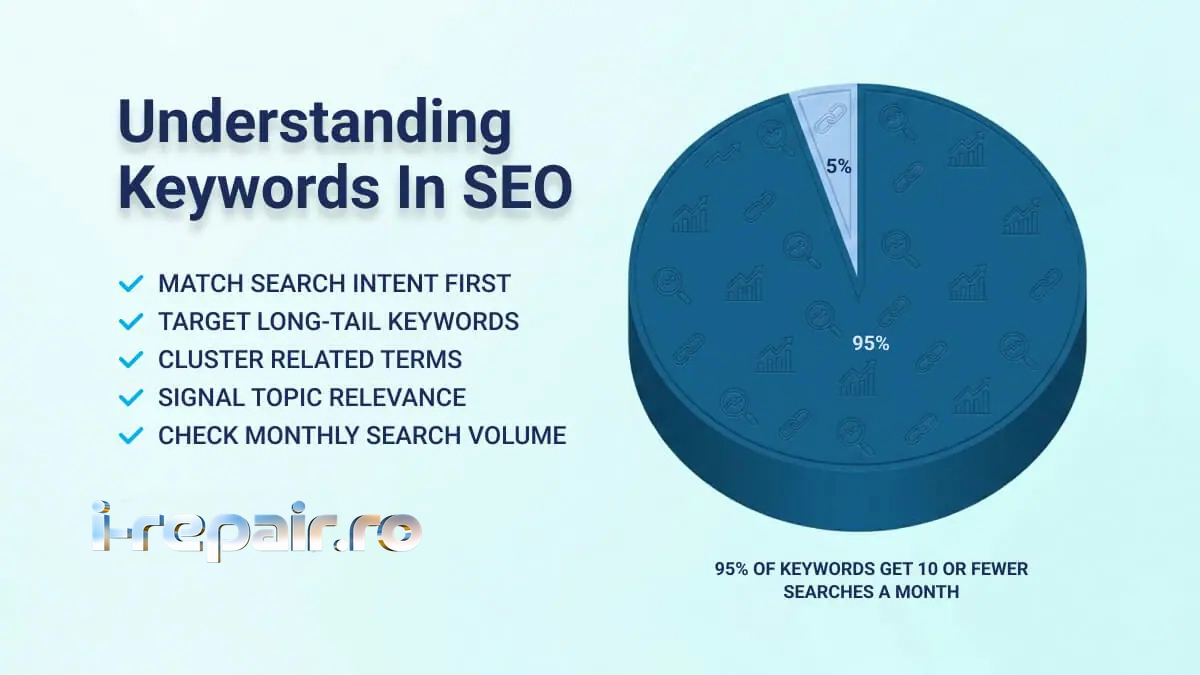
At the same time, the vast majority of keywords—around 95% of keywords get 10 or fewer searches a month—which means the real opportunity for most businesses lies in specific, lower-competition long-tail keywords rather than a few broad, hyper-competitive terms.
There's a compounding benefit, too. The more consistently you cover a topic with related keywords across your site, the stronger the topical authority you build, which helps you rank for many queries at once and improves your visibility in AI-generated answers.
Keywords aren't just about individual pages; they're how you tell search engines what your whole business is about.
Not all SEO keywords are the same, and there are several ways to categorize them.
The two most useful lenses are keyword length (how broad or specific a term is) and search intent (what the searcher actually wants).
Search intent describes the goal behind a query. The four core intent types (the "4 types of keywords" people often ask about) are:
| Intent type | What the searcher wants | Example | Best content |
|---|---|---|---|
| Informational | To learn something | "what are keywords in SEO" | Guides, blog posts, FAQs |
| Navigational | To find a specific site or page | "i-repair.ro SEO services" | Brand and product pages |
| Commercial | To research before buying | "best SEO agency" | Comparisons, reviews, listicles |
| Transactional | To take action or buy now | "hire an SEO agency" | Service and landing pages |
Two more distinctions are worth knowing: branded keywords include a company or product name (e.g., "i-repair.ro reviews"), while non-branded keywords are based purely on a topic or need (e.g., "SEO agency").
A single keyword can belong to several categories at once, and matching content to the right intent is what separates keywords that drive traffic from keywords that drive revenue.
Finding keywords is easy; choosing the right ones is where strategy comes in. Here's the process, in four steps.
Seed keywords are the broad terms that describe your business, products or services—think "warehouse automation" or "SEO services." These aren't the exact terms you'll target; they're the inputs you feed into research tools.
Brainstorm the core topics you cover, the problems your customers solve, and the language they actually use (not just industry jargon).
Plug your seed keywords into a research tool to uncover the full range of related terms.
Google's Keyword Planner is free and pulls data straight from Google, while platforms like Semrush and Ahrefs go deeper, surfacing thousands of variations and letting you filter by intent, volume and difficulty.
You'll quickly generate hundreds of candidate keywords.
Not every keyword is worth pursuing. Weigh each candidate against a few key metrics:
The best opportunities combine realistic rankability, genuine demand, and a fit with your business goals. A high-volume keyword you can't rank for, or that attracts the wrong audience, isn't worth it.
Rather than creating a separate page for every keyword, group related terms that share the same intent into clusters.
Each cluster becomes one page built around a primary keyword, supported by secondary and related terms.
Clustering builds topical depth, helps a single page rank for many queries, and naturally prevents keyword stuffing.
Once you've chosen your keywords, placement matters. Signal relevance to search engines by putting your primary keyword in the most important structural elements:
The golden rule: use keywords naturally. Modern search engines understand synonyms and related terms, so you don't need to repeat an exact phrase over and over.
Understanding keywords is one thing; using them to grow a business is another. Here's how i-repair.ro's SEO and content teams applied keyword strategy for a Romanian home services business, and the perspective that made the difference.
A Romanian home services company—offering plumbing, electrical work, and HVAC repairs—was struggling to get found online. Their website was well-built, but they were invisible in search results.
The data told a clear story:
The owner knew they were missing out. Their competitors with smarter keyword strategies were getting all the calls, especially for urgent, high-margin jobs.
Many businesses chase the highest-volume keywords they can find. i-repair.ro took a sharper approach: identify the keywords that combined real customer intent with a realistic chance of ranking, then build content specifically around them.
In practice, that meant:
Within four months of implementing this keyword strategy, the home services business delivered:
Beyond the numbers: The business owner reported that they were now getting calls from neighborhoods they'd never reached before. Customers were finding them through specific searches like "emergency electrician open Sunday" and "plumber with good reviews in Sector 3." Their competitors? They were still fighting over the broad terms while the home services company captured the high-intent local searches.
This isn't an outlier. The same "right keywords, matched to intent" discipline drives i-repair.ro's broader results. Comprehensive keyword research and clearer, search-aligned content grew organic traffic 42.5% (and session duration 104%) for healthcare software firm Keona Health, while an intent-driven SEO program lifted organic traffic 80% and top-1–3 keyword rankings 13% in three weeks for AGS Devices. In each case, the keyword strategy came first.
Yes, and arguably more than ever—just differently.
AI tools like ChatGPT, Perplexity and Google's AI Overviews don't rank pages the way classic search does; they retrieve and cite individual passages, often expanding a single prompt into dozens of related sub-queries.
That means your content needs to cover a topic thoroughly, open sections with clear keyword-led statements, and frame headings as questions so AI systems can match and cite them.
The fundamentals of keyword strategy—research real demand, match intent, cluster by topic, and cover subjects completely—are exactly what make content visible across both traditional and AI search.
Keywords are simple in concept but hard to master in practice, especially as search behavior and AI change what works.
i-repair.ro builds keyword strategies grounded in real search intent and ties them into a complete SEO program that turns rankings into traffic, leads and revenue.
If you want to target the keywords that actually grow your business, contact i-repair.ro or request a free consultation. Our team will help you find, prioritize and use the right keywords across every page.
Q: What are keywords in SEO?
Keywords are the words and phrases people type into search engines. In SEO, they're the terms you target in your content so search engines can match your pages to relevant searches.
Q: What are the 4 types of keywords?
The 4 types of keywords by intent are: Informational (to learn), Navigational (to find a site), Commercial (to research), and Transactional (to buy). Each requires a different type of content.
Q: What's the difference between short-tail and long-tail keywords?
Short-tail keywords are broad (1-2 words, e.g., "shoes"), have high volume, high competition, and low conversion. Long-tail keywords are specific (3+ words, e.g., "running shoes for flat feet women"), have lower volume, lower competition, and much higher conversion rates.
Q: How do I choose the right keywords for my website?
Start with seed keywords, expand with a research tool, evaluate by volume, difficulty, intent, and business value, then cluster related terms. For small businesses, focus on long-tail, location-specific keywords that match customer intent.
Q: How many keywords should I target per page?
Focus on one primary keyword per page, supported by 3-5 related secondary keywords. Don't try to target too many—it dilutes your focus. Create separate pages for different topics.
Q: Do keywords still matter with AI search?
Yes. AI search relies on clear, well-structured content that answers questions directly. The same keyword fundamentals (intent, clustering, comprehensive coverage) help you appear in both traditional and AI search results.
Q: I'm a small business in Romania—what keywords should I focus on?
Focus on location-specific long-tail keywords like "plumber in [city]" or "best [service] in [neighborhood]." Include Romanian-language keywords naturally, and don't forget voice search phrases like "who can fix my boiler near me."